
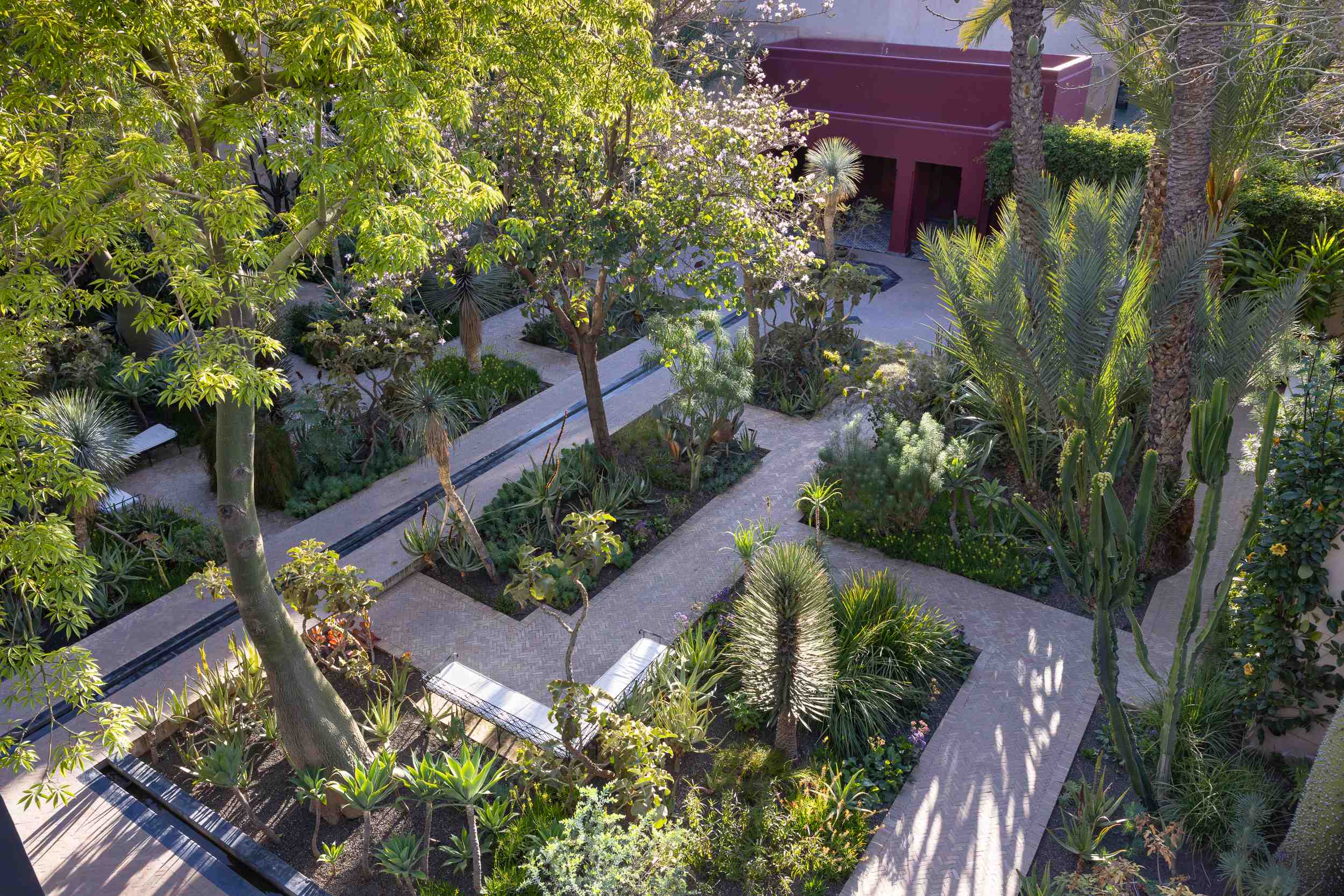
The aesthetic of the Ochre City is not limited to its vibrant colors; it lies in the finesse of its structural details. traditional architecture in marrakech is a living testimony to a craftsmanship that combines utility and spirituality. Among the most emblematic elements, columns and fountains occupy a central place, structuring the space while offering a poetic dimension to islamic architecture in marrakech. These elements are not mere ornaments; they are the language through which builders expressed their vision of the world.
In palaces and riads, the column is more than just a load-bearing support. It is a transitional element between the shade of the galleries and the light of the patio. traditional architecture in marrakech uses the column to create a visual rhythm that guides the gaze toward the sky, symbolizing ascension and lightness despite the density of the materials used.
Builders often favored terracotta brick or hewn stone, covered with carved plaster or tadelakt. In islamic architecture in marrakech, these columns are frequently crowned with capitals adorned with floral or geometric motifs, symbolizing growth and the infinite. The plaster carving, done by hand, requires a mathematical precision that reflects divine order.
Columns support arcades that protect living quarters from direct sunlight. This architectural device helps maintain a mild temperature while offering plays of light and shadow that change throughout the day. The arches, whether pointed or semicircular, add a visual dynamic that breaks the monotony of horizontal lines.
Water is the sacred element par excellence. In every interior courtyard, the fountain serves as a focal point, both visually and acoustically. It embodies life and purity, two fundamental pillars of islamic architecture in marrakech. Without water, the garden and the riad lose their paradisiacal dimension.
Often located at the entrance or in a corner of the patio, the wall fountain is a masterpiece of mosaic. The work of zellige, with its complex mathematical patterns, perfectly illustrates the richness of traditional architecture in marrakech. Each tile color has a meaning: blue for the sky, green for nature, and white for purity. The water flows gently, cooling the ambient air through evaporation.
In the center of the garden or patio, the low basin encourages reflection. The mirror of water visually doubles the height of the surrounding facades, creating a sense of absolute space and serenity. This is where the harmony of islamic architecture in marrakech reaches its peak, uniting the liquid element with the solidity of stone in perfect symmetry.
Islamic architecture does not separate the building from the landscape. The concept of the "Chahar Bagh" (four-part garden) is omnipresent. Fountains are not placed randomly; they mark the intersection of paths leading toward knowledge and peace. This spatial organization of traditional architecture in marrakech aims to recreate an oasis of freshness in an arid climate.
The integration of these fountains relied on a complex system of pipes called Khettaras. This civil engineering is inseparable from traditional architecture in marrakech, as it allowed water to be brought from the Atlas Mountains to the heart of urban dwellings using the simple force of gravity. These underground galleries prevented evaporation and guaranteed pure water for rituals and the cooling of gardens.
The murmur of the water is not accidental. It is calculated to mask the noises of the street, creating an acoustic cocoon where meditation becomes natural. This is one of the most subtle aspects of islamic architecture in marrakech: architecture does not just address the eyes, but all the senses.
On your next visit to a historical monument, check these details:
The finesse of the carvings on the column capitals, often unique from one row to the next.
The color gradients of the zelliges in the wall fountain, revealing the age of the work.
The perfect symmetry of the basin in relation to the axes of the doors and windows.
The use of cedar wood in the upper sections to protect structures from erosion.
The water drainage system, often discreetly integrated into the floor through channels.
Pairing columns allows for a slimmer silhouette while providing a wider support base for heavy brick or plaster arches. This gives an impression of airy lightness while ensuring maximum structural stability.
Beyond coolness, it recalls the paradise described in ancient texts as a garden where streams flow. It is also linked to ablutions and the purification of the soul.
In carefully restored sites like Le Jardin Secret, the hydraulic systems have been rehabilitated to respect the authenticity of traditional architecture in marrakech, sometimes using modern filtration techniques while maintaining the original appearance.
Gueliz stone is often used, a local limestone whose hue harmonizes perfectly with lime coatings and the surrounding pisé (rammed earth).
To understand the visual power of columns and the serenity of fountains, a visit is a must. Le Jardin Secret is an open-air laboratory of traditional architecture in marrakech. You can admire the precision of the craftsmen and the way islamic architecture in marrakech has mastered the elements to create an exceptional space, a true oasis in the middle of the medina.
Come contemplate the perfect marriage between stone, plaster, and water, and let yourself be inspired by centuries of architectural history where every detail tells a story of devotion and beauty.