
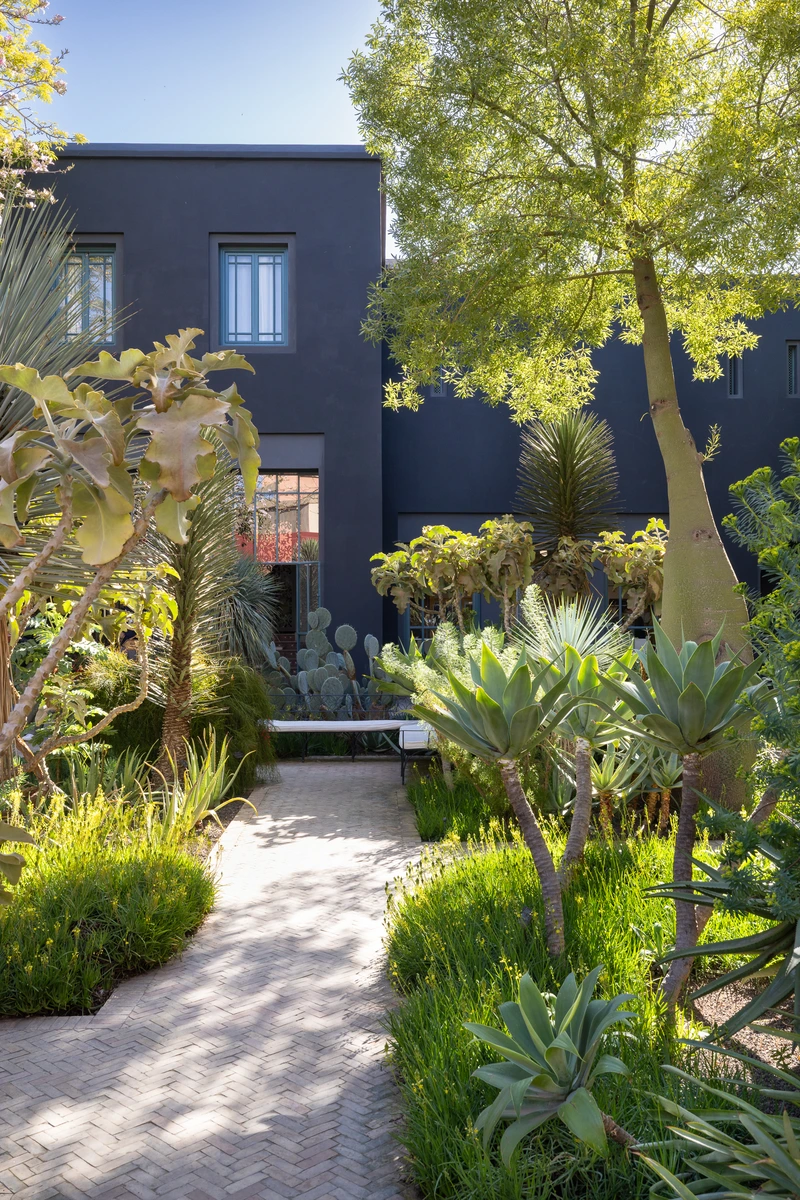
The historic riads of Marrakech constitute the very essence of the medina's urban design. These dwellings, whose name literally means garden in Arabic, represent a thousand-year-old art of living where architecture fades behind austere walls to reveal treasures of interior refinement. Far from being simple houses, they are architectural metaphors for paradise on earth.
The influence of Andalusia and the East shaped the structure of the historic riads of Marrakech. Initially designed for notable families, these buildings met specific climatic and social needs: protecting family privacy and offering constant natural coolness. The introverted nature of the building reflects a cultural priority on the inner world rather than outward display.
The patio is the beating heart of the riad. Unlike a classic house, all rooms face this open-air center, often adorned with a fountain and four symmetrical planting beds. This four-part division, known as the Char-Bagh, symbolizes the four rivers of Paradise mentioned in ancient texts.
Every element in the historic riads of Marrakech serves a higher purpose. The central fountain is not just a decorative piece; the sound of flowing water is intended to mask the noise of the bustling streets outside, creating a meditative environment that fosters peace and reflection.
To build the most beautiful riads in Marrakech, master craftsmen, or Maâlems, use ancestral techniques that have crossed centuries without losing their splendor. These artisans work with raw materials extracted from the Moroccan soil, ensuring a biological harmony between the building and its environment.
Atlas cedar is preferred for carved ceilings and monumental doors. Its resistance and natural fragrance add a unique sensory dimension to the reception areas. In many of the most beautiful riads in Marrakech, you will find "Zouak" painting—a technique where intricate floral or geometric patterns are hand-painted onto the wood.
Zellige, glazed terracotta tile mosaic, adorns the floors and the base of columns with complex geometric patterns. These designs are mathematical masterpieces, representing the infinite nature of creation. Above the tiles, carved stucco, or Gebs, provides a stone lace that filters the light, creating a play of shadows that changes throughout the day.
While the basic structures remain faithful to tradition, the use of riads has evolved. Many historic riads of Marrakech have been restored to become prestigious guest houses or cultural centers, preserving thus a heritage that was at risk of disappearing during the mid-20th century.
Restoring a riad requires a delicate balance between modern comfort and historical integrity. Today, the most beautiful riads in Marrakech successfully integrate sustainable cooling systems and contemporary lighting without compromising the original soul of the Maâlems' work.
An authentic riad can be recognized by several key elements that guarantee its historical character:
The presence of a symmetrical garden divided into four parts.
A functional central fountain for the soothing sound of water.
B'hous, alcôves open to the patio for resting in the shade.
A terrace offering a panoramic view of the Atlas Mountains and the Koutoubia.
The use of Tadelakt—a waterproof lime plaster—in the bathrooms and hammams.
Here are the essential points to check during a visit to identify true historic riads of Marrakech:
An architectural structure closed to the outside with no street windows.
Exclusive use of traditional materials (tadelakt, zellige, cedar).
Proportions that respect the Islamic golden ratio and traditional scales.
Presence of original "Khokha" doors (a small door within a larger monumental gate).
Absence of modern structural modifications that distort the central patio's symmetry.
A dar is a traditional house organized around a patio, but unlike a riad, it does not necessarily have a planted interior garden with trees. Riads are generally larger and focus more on the botanical element.
Local philosophy prioritizes interior wealth over exterior appearance, thus avoiding ostentation and protecting private life from prying eyes. It is a philosophy of "the hidden treasure."
In addition to private guest houses, places like Le Jardin Secret or the Mouassine Museum offer the purest examples of historical restoration and are open to the public for cultural exploration.
The patio creates a cooling well: hot air rises and escapes through the top, while the evaporation from the fountain and vegetation cools the galleries. The thick earth walls provide thermal inertia, keeping the interior cool in summer and warm in winter.
Theory never replaces the sensory experience of wandering through the walls of a restored palace. To understand the magic of the historic riads of Marrakech, we invite you to discover Le Jardin Secret. This monument is a rare example of a grand riad that has preserved its dual nature: an Islamic garden of deep symbolic meaning and an exotic garden featuring plants from all over the world.