To understand the mesmerizing beauty of traditional Moroccan design, one must look beyond the surface aesthetics and explore the profound relationship between mathematics and the divine. In the Islamic worldview, the physical universe is not a chaotic collection of random events, but a perfectly ordered creation governed by laws that can be expressed through geometry. Painters and builders utilized compasses and straightedges to divide space with absolute precision, starting with a simple circle. By dividing a circle into $4$-fold, $6$-fold, or $8$-fold symmetry, artisans created intricate grids that formed the basis for every pattern. This mathematical approach to design is a defining hallmark of Islamic architecture in Marrakech, where buildings act as physical manifestations of cosmic order.
This geometric system is deeply spiritual; it reflects the concept of Tawhid, the oneness and unity of God. The circle represents infinity, having no beginning and no end, symbolizing the eternal nature of the divine. As the circle is divided to generate polygons and stars, the resulting patterns remind the observer that multiplicity arises from a single, unified source. Throughout the city's historic monuments, these geometric grids create a sense of balance and calm. Visitors studying the walls of ancient palaces are experiencing a physical translation of metaphysical truths, where complex calculations serve to elevate the human mind toward contemplation of the infinite.
The art of zellige, the hand-cut enameled terracotta tilework, represents the pinnacle of mathematical tessellation. Artisans, known as Maâlems, assemble thousands of tiny, precisely chiseled clay shapes into repeating patterns that cover floors, fountains, and the lower portions of walls. Mathematically, these designs rely on Euclidean geometry to fill a $2$-D plane without overlaps or gaps, using repeating polygons. The complexity of these grids, often featuring stars with $8$, $12$, $16$, or even $24$ points, requires an intuitive understanding of trigonometry and symmetry groups. This dedication to structural perfection makes zellige one of the most remarkable features of Islamic architecture in Marrakech.
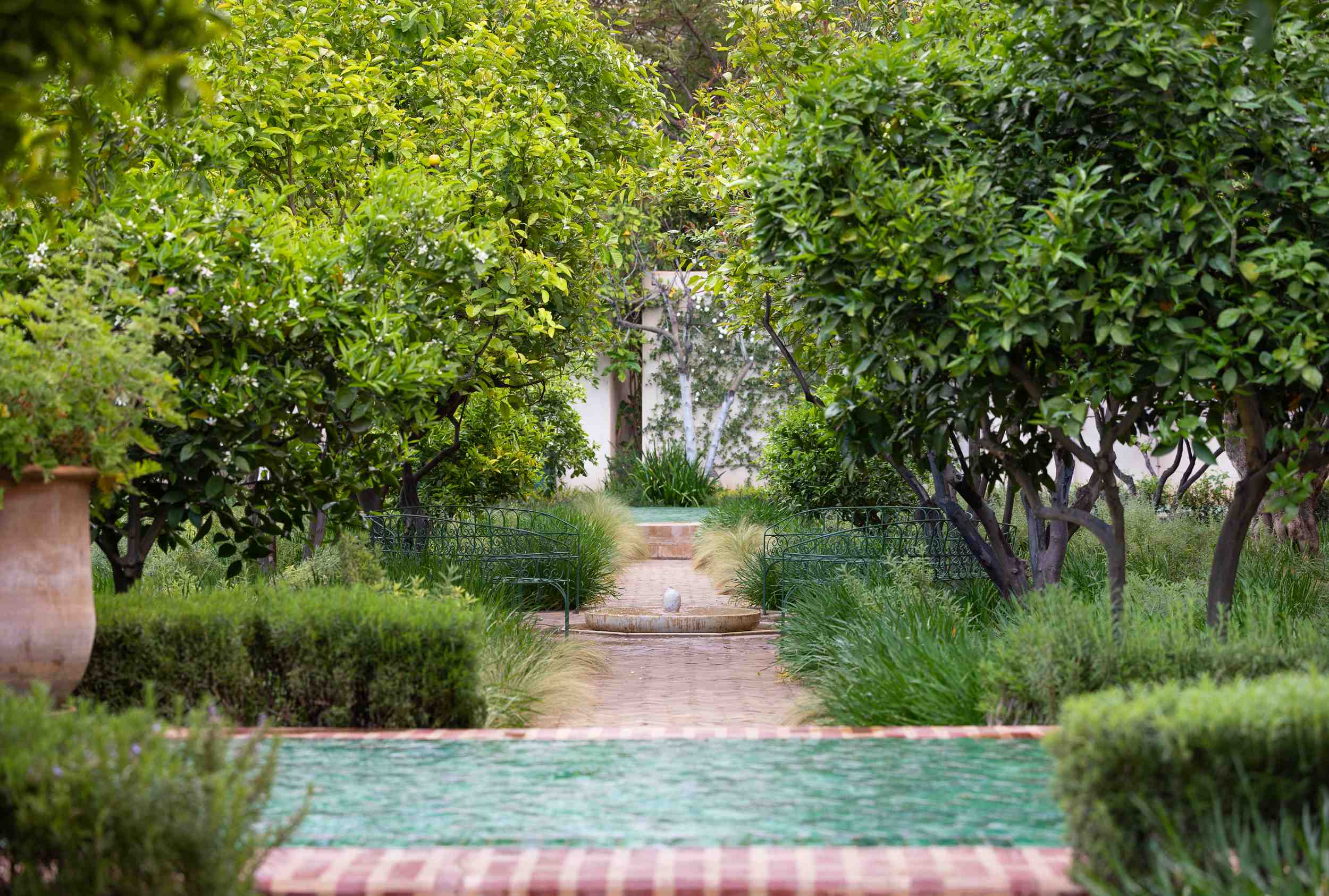
Spiritually, zellige patterns are designed to suggest the concept of infinity. Because the motifs can theoretically expand forever in any direction beyond the physical boundaries of the wall or floor, they remind the viewer of the limitless nature of creation. The deliberate use of contrasting colors—such as deep cobalt blue, emerald green, and safran yellow—creates a rhythmic movement that draws the eye inward, encouraging a meditative state. In quiet palaces and restored gardens like Le Jardin Secret, the harmony of these interlocking tiles provides an anchor for the mind, allowing visitors to appreciate how rigorous mathematical discipline can be harnessed to create spaces of profound spiritual peace.
While zellige anchors the lower half of spaces with colorful, geometric stability, carved plasterwork, or gebs, elevates the upper walls and ceilings with fluid, organic forms. This artwork relies on the arabesque, a design consisting of repeating, interlacing foliage and floral motifs that wind gracefully across surfaces. The mathematics of the arabesque are found in its spiraling curves and logarithmic spirals, which mimic the natural growth patterns found in shells, plants, and galaxies. When integrated into the structures of Islamic architecture in Marrakech, carved stucco bridges the gap between the gap of rigid geometry and the organic flow of the living world.
The spiritual symbolism of the arabesque is closely tied to the concept of the divine breath of life, animating the material world. The continuous, flowing lines do not represent real, decaying plants, but rather the idealized, eternal essence of nature. When looking at the delicate plaster arches of a historic pavilion, the viewer is invited to contemplate the unseen forces that sustain life. Furthermore, plaster is carved by hand while still damp, requiring immense focus and rhythm from the artisan. This process is itself a form of active meditation, where every strike of the chisel is a physical prayer, embedding spiritual devotion directly into the fabric of the building.
The table below breaks down the primary ornamental elements of traditional Moroccan design, mapping their mathematical bases, spiritual symbolisms, and architectural context.
|
Ornamental Element |
Mathematical Basis |
Spiritual Symbolism |
Presence in Marrakech |
|---|---|---|---|
|
Zellige Tilework |
$2$-D Euclidean plane tessellation, $8$-fold, $12$-fold, and $16$-fold symmetry groups |
The concept of infinity, multiplicity arising from a single, unified divine source |
Lower walls, columns, courtyards, and fountains of historic structures |
|
Carved Stucco (Gebs) |
Logarithmic spirals, scaling proportions, organic curves, and symmetry planes |
The divine breath of life (Nafas ar-Rahman), representing eternal growth and creation |
Upper walls, transition zones beneath wooden ceilings, and exterior arches |
|
Muqarnas (Honeycomb Plaster) |
$3$-D projection of $2$-D geometric grids, stereotomical corbel structures |
The transition from the terrestrial realm (square base) to the heavens (dome) |
Interior domes, transition corners, niches, and monumental entry gateways |
|
Carved Cedarwood (Zouak) |
Bilateral symmetry, radial subdivision, and proportional golden ratio framing |
Nature's cosmic order, reflecting the beauty and divine structure of the universe |
Ceilings, massive lintels, window screens (mashrabiya), and monumental doors |
Why does Islamic architecture in Marrakech avoid drawing human figures? Traditional design avoids figurative art to prevent idolatry, redirecting the viewer's focus toward the abstract beauty, harmony, and perfection of creation.
What is the spiritual meaning of the star patterns in Moroccan tiles? The central star represents the divine light radiating into the universe. The intersecting lines symbolize how all created things originate from a single source of unity.
How do math and symmetry contribute to the calm atmosphere of historic sites? Symmetry creates visual balance, which reduces cognitive load on our brains. This mathematical order induces a state of calm, making these buildings peaceful sanctuaries.
Is Le Jardin Secret a good place to study traditional patterns? Yes. Its meticulously restored pavilions, zellige fountains, and geometric gardens show how mathematics and spiritual symbolism combine to create a peaceful, harmonious environment.
Is there sometimes a deliberate mistake in these geometric patterns? Yes. Artisans often left a subtle asymmetry to express humility, believing that only the Divine creator can achieve absolute, flawless perfection. This is a key philosophy in Islamic architecture in Marrakech.
How does the circle relate to infinity in these designs? The circle has no beginning or end, representing eternity. All complex patterns originate from its division, showing how multiplicity flows from unity.
What is the significance of the $8$-fold star pattern? The $8$-fold star, known as the Khatam, symbolizes balance and is a core geometric emblem representing the intersection of physical space and spiritual realms.
Discover the history of Le Jardin Secret and book your visit now