
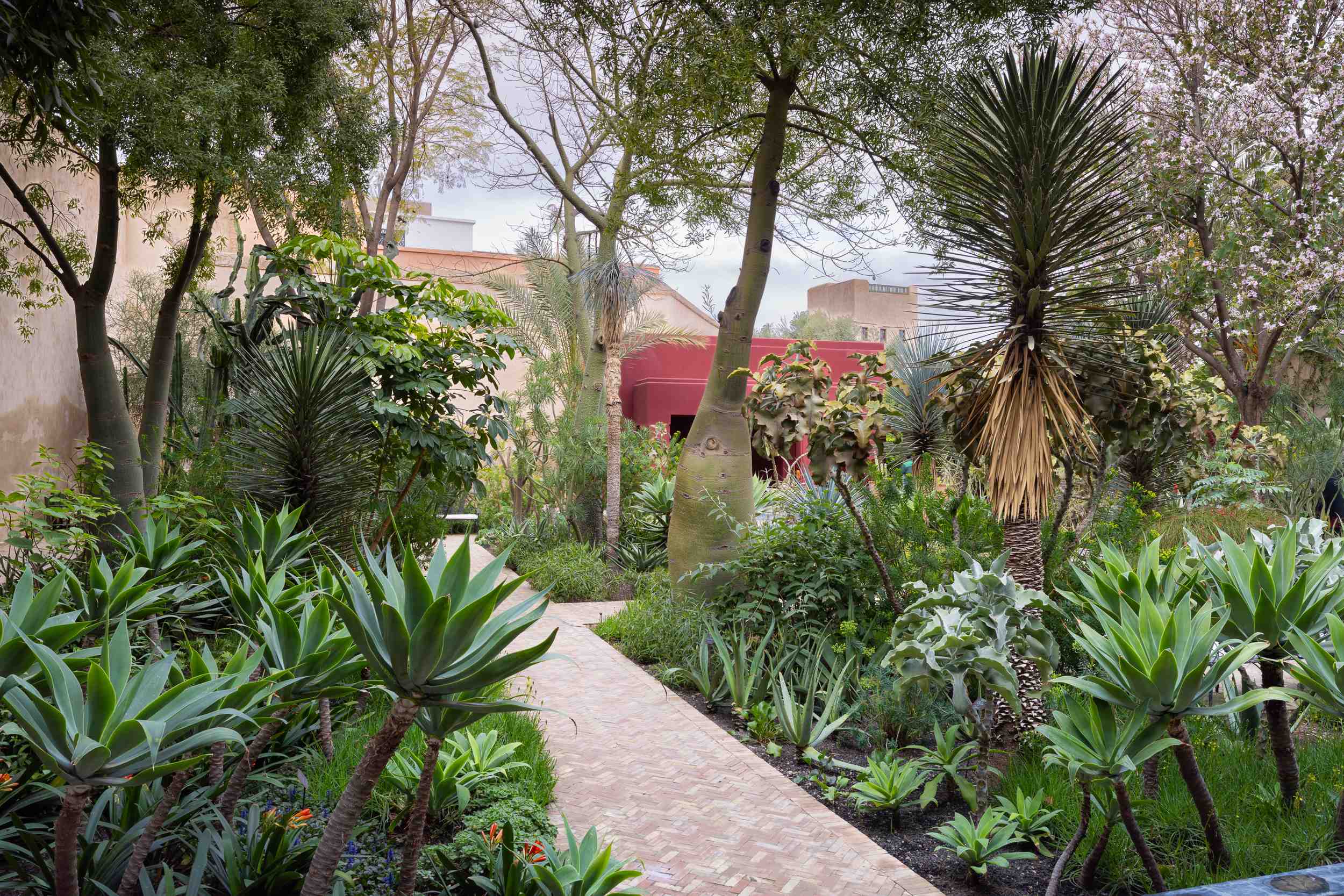
To understand what elevates an authentic Moroccan riad to the status of a heritage monument, one must analyze the layout of the riads historiques de Marrakech. The word riad stems from the Arabic term riyad, which translates to garden. Historically, these urban mansions were not merely residential spaces; they were private sanctuaries designed to mirror the heavenly gardens described in spiritual texts. The classic structure of a true historic riad is defined by an inward-looking, symmetric $4$-sided central courtyard. This open-air patio acts as the physical and metaphorical center of the home, around which all residential quarters are arranged, defining the timeless appeal of a traditional courtyard home.
The spatial configuration of these historic structures follows strict geometric alignments. By designing rooms that are narrow and elongated, master builders maximized the load-bearing capacity of traditional timber beams while ensuring that every room opened directly onto the central garden. The absence of outward-facing windows is a deliberate architectural feature. It serves a dual purpose: ensuring absolute familial privacy and creating a barrier against the acoustic and thermal stresses of the bustling streets. This structural intimacy is what distinguishes these ancestral homes from modern villas, placing them among les plus beaux riads de Marrakech for travelers seeking authenticity.
A true heritage riad is a living showcase of Moroccan master craftsmanship, utilizing locally sourced, organic materials that have been worked by hand using centuries-old techniques. The lower portions of the walls, columns, and fountains are typically decorated with hand-cut clay tiles known as zellige. Each individual tile is manually chiseled into precise geometric shapes to form infinite tessellations, creating a vibrant $2$-D plane that contrasts with the neutral tones of the surrounding masonry.
As you look upward, the masonry transitions into intricate carved plasterwork, or gebs. This artisan technique involves applying layers of gypsum plaster to the walls and carving intricate geometric or calligraphic patterns by hand while the material is still damp. This is complemented by massive structural beams and decorative window screens, known as mashrabiya, made from Atlas cedarwood. Many of les plus beaux riads de Marrakech feature painted cedarwood ceilings using the zouak technique, where natural mineral pigments like saffron, indigo, and cobalt are applied to create symmetric floral patterns. These natural materials age with a distinct patina, adding a layer of historical narrative that modern imitations cannot replicate, a hallmark of heritage monuments in Morocco.
Beyond their visual and cultural splendor, the riads historiques de Marrakech are masterpieces of environmental engineering. Long before the advent of modern air conditioning, Moroccan builders developed passive cooling architecture that maintained a comfortable indoor climate throughout the scorching summer months. This thermodynamic efficiency relies on the structural physics of the building's envelope and the central patio.
The external walls of a historic riad are constructed using rammed earth or thick clay bricks, providing a high thermal mass that slows down the transfer of heat from the exterior. During the day, the open courtyard acts as a chimney, drawing hot air upward and out of the building, while the cooler, shaded air inside the rooms remains settled. The presence of a central water feature, such as a marble fountain or a plunging pool, introduces evaporative cooling to the microclimate of the patio. This combination of structural mass, natural ventilation, and moisture regulation makes these heritage properties exceptionally sustainable and comfortable to inhabit.
The table below highlights the fundamental differences in design, materials, and engineering between authentic historic riads and contemporary modern adaptations.
|
Architectural Element |
Historic Heritage Riad |
Contemporary Modern Riad |
|---|---|---|
|
Spatial Layout |
Symmetric $4$-sided patio with a central garden or fountain |
Irregular courtyard, often dominated by a large swimming pool |
|
Primary Materials |
Rammed earth, lime plaster (tadelakt), hand-cut zellige, and cedarwood |
Concrete, drywall, machine-cut tiles, and synthetic materials |
|
Ventilation & Cooling |
Passive thermal chimney effect, high thermal mass, and natural shade |
Active mechanical air conditioning, large glass panels |
|
Artisanal Finish |
Hand-engraved plaster (gebs) and hand-painted wood (zouak) |
Molded plaster, printed wallpaper, and standardized industrial finishes |
|
Intimacy Level |
Complete visual and acoustic isolation from the public street |
Semi-exposed layouts, larger outward-facing windows |
How can you tell if a Riad is truly historic? An authentic historic Riad is identified by its load-bearing rammed earth or brick walls, hand-carved plasterwork, and a symmetric courtyard garden. It belongs to the collection of riads historiques de Marrakech if its layout is entirely inward-looking with zero street-facing windows.
Why are rooms in historic riads so long and narrow? The room proportions were dictated by the span of the Atlas cedarwood timber used for the ceilings. Since traditional wooden beams rarely exceeded a length of $3$ to $4$ meters, the rooms had to be built narrow and elongated to maintain structural integrity.
How does the water fountain contribute to the climate of the riad? The fountain is a functional cooling device. Through evaporative cooling, the water features in les plus beaux riads de Marrakech lower the surrounding air temperature by several degrees while creating an acoustic buffer against external noise.
What is the significance of the central courtyard garden? The courtyard garden represents a $3$-dimensional oasis of peace. It provides light and fresh air to the surrounding rooms while symbolizing the spiritual concept of an inner paradise, protected from the outside world.
Discover the history of Le Jardin Secret and book your visit now